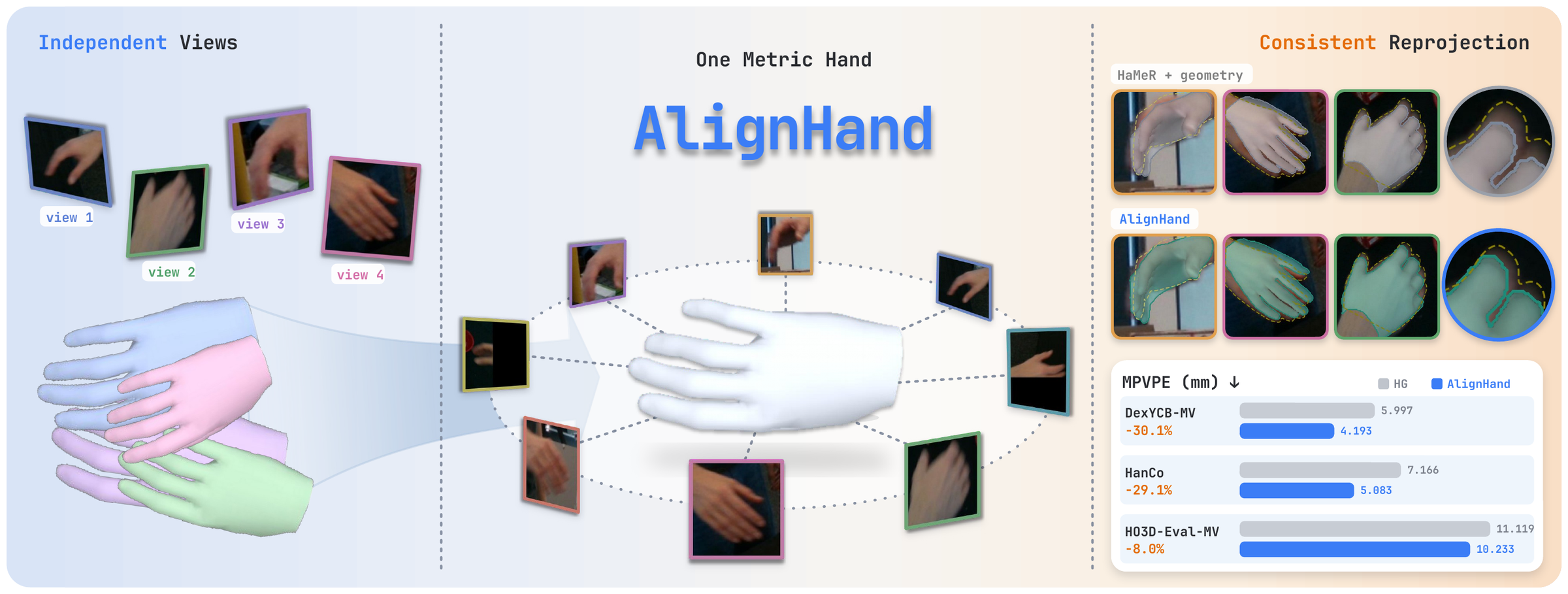
From independent monocular predictions to a consistent metric hand.
Abstract
Modern monocular hand estimators recover detailed 3D meshes from individual images, yet effectively leveraging their predictions across multiple views remains challenging. Independently predicted meshes can disagree in scale, placement, and articulation, limiting the integration of complementary multi-view information. Hence, we present AlignHand, a calibrated multi-view framework that builds on a frozen monocular hand reconstruction prior to align and enhance its predictions. Specifically, AlignHand refines cross-view joint observations and estimates their reliability to establish a shared metric reference for alignment. Once the meshes are brought into a common frame, their complementary surface evidence is selectively fused across anatomical regions, followed by pixel-aligned refinement that predicts bounded residual displacements from local image features. This global-to-local integration enables AlignHand to exploit complementary observations while preserving the strong monocular prior. Extensive experiments on DexYCB-MV, HanCo, and HO3D-Eval-MV demonstrate that AlignHand achieves the lowest MPVPE and MPJPE among the compared methods under the respective evaluation protocols, reducing MPVPE by 30.1%, 29.1%, and 8.0%, respectively, compared with a matched geometry baseline.
AlignHand at a Glance
Reductions relative to the matched HaMeR + geometry baseline.
Key Contributions
- Prior-preserving multi-view integration. AlignHand keeps a strong monocular estimator frozen and learns only how to combine its per-view predictions, with 0.98M trainable parameters.
- Global-to-local integration. Reliability-weighted metric alignment brings independent meshes into one frame; region-wise fusion and pixel-aligned refinement then combine their complementary surface evidence.
- One model, consistent gains. A single model trained on the pooled DexYCB, HanCo and HO3D training splits achieves the lowest MPVPE and MPJPE among the compared methods on DexYCB-MV, HanCo and HO3D-Eval-MV.
Method
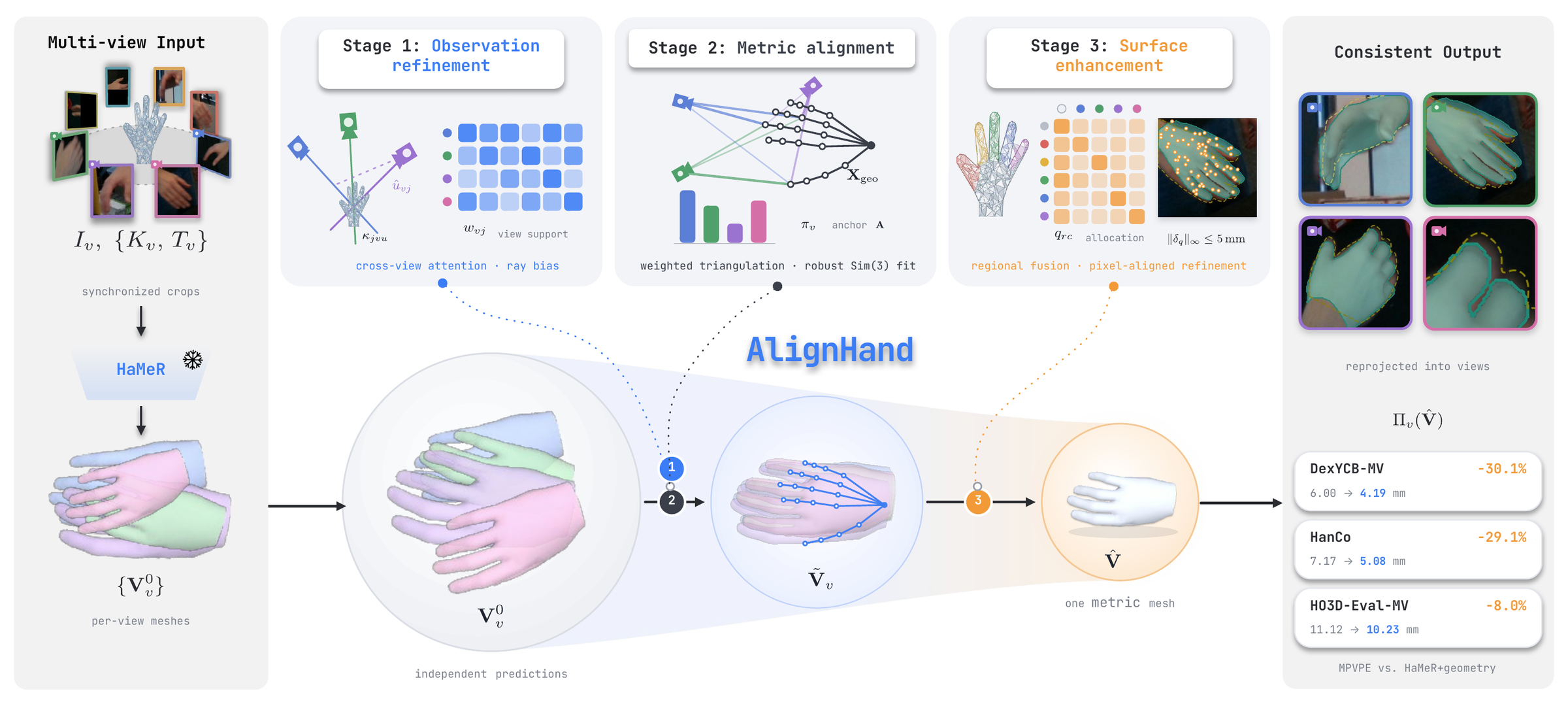
Observation refinement
Cross-view attention corrects the 2D joint observations and estimates a reliability weight for every joint in every view.
Metric alignment
Reliability-weighted triangulation builds a shared metric skeleton, and each monocular mesh is aligned to it.
Surface enhancement
The aligned meshes are fused separately for the palm and each finger, then refined with local image features.
Frozen monocular backbone · 0.98M trainable integration parameters · One shared integration model
The shared model is trained on the pooled training splits of DexYCB, HanCo, and HO3D.
Results
Test-set MPVPE / MPJPE (mm, lower is better) of one shared model.
| Dataset | Views | HG | AlignHand | MPVPE reduction |
|---|---|---|---|---|
| DexYCB-MV | 8 | 5.997 / 5.892 | 4.193 / 4.090 | 30.1% |
| HanCo | 8 | 7.166 / 6.643 | 5.083 / 4.587 | 29.1% |
| HO3D-Eval-MV | 5 | 11.119 / 10.875 | 10.233 / 9.882 | 8.0% |
Table 1. HG is the HaMeR + geometry baseline built from the same frozen predictions. AlignHand improves on every test set with one shared model.
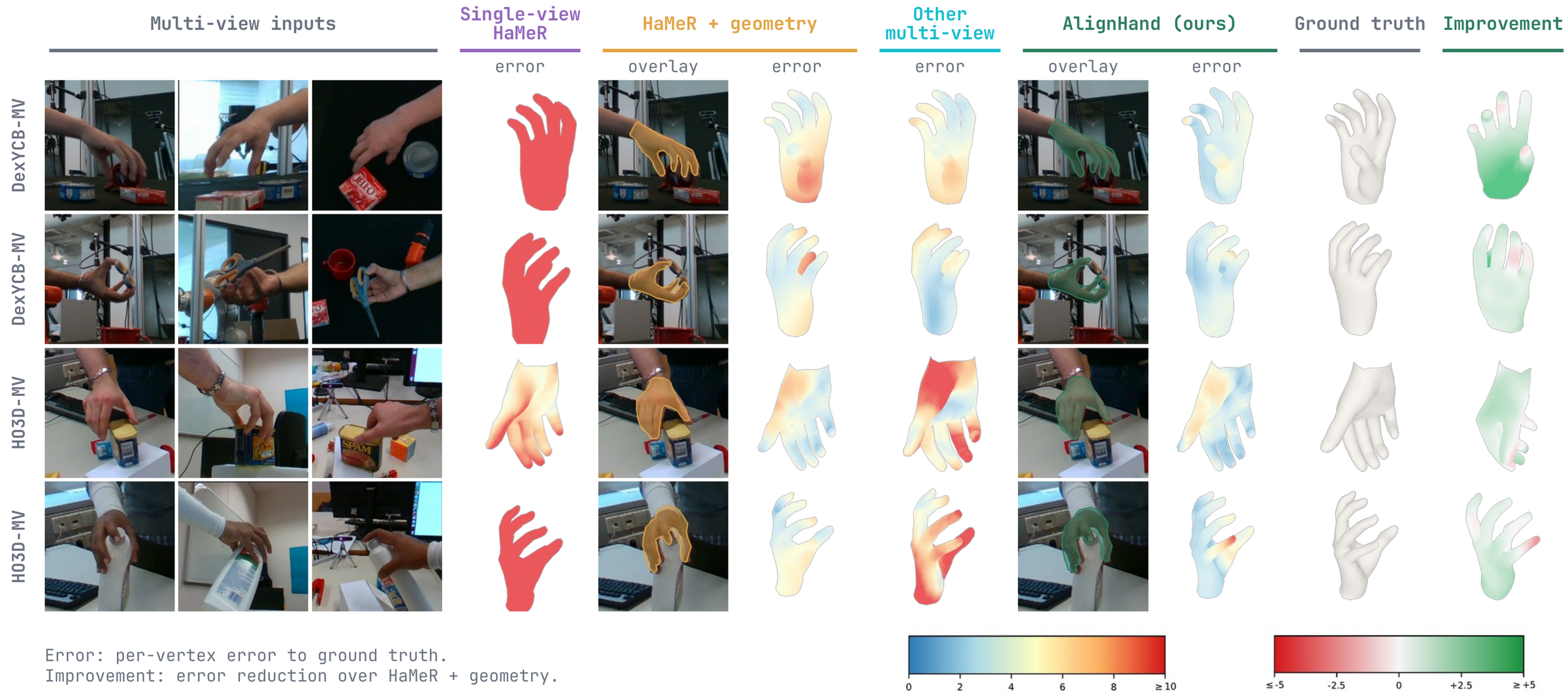
Ablation Study
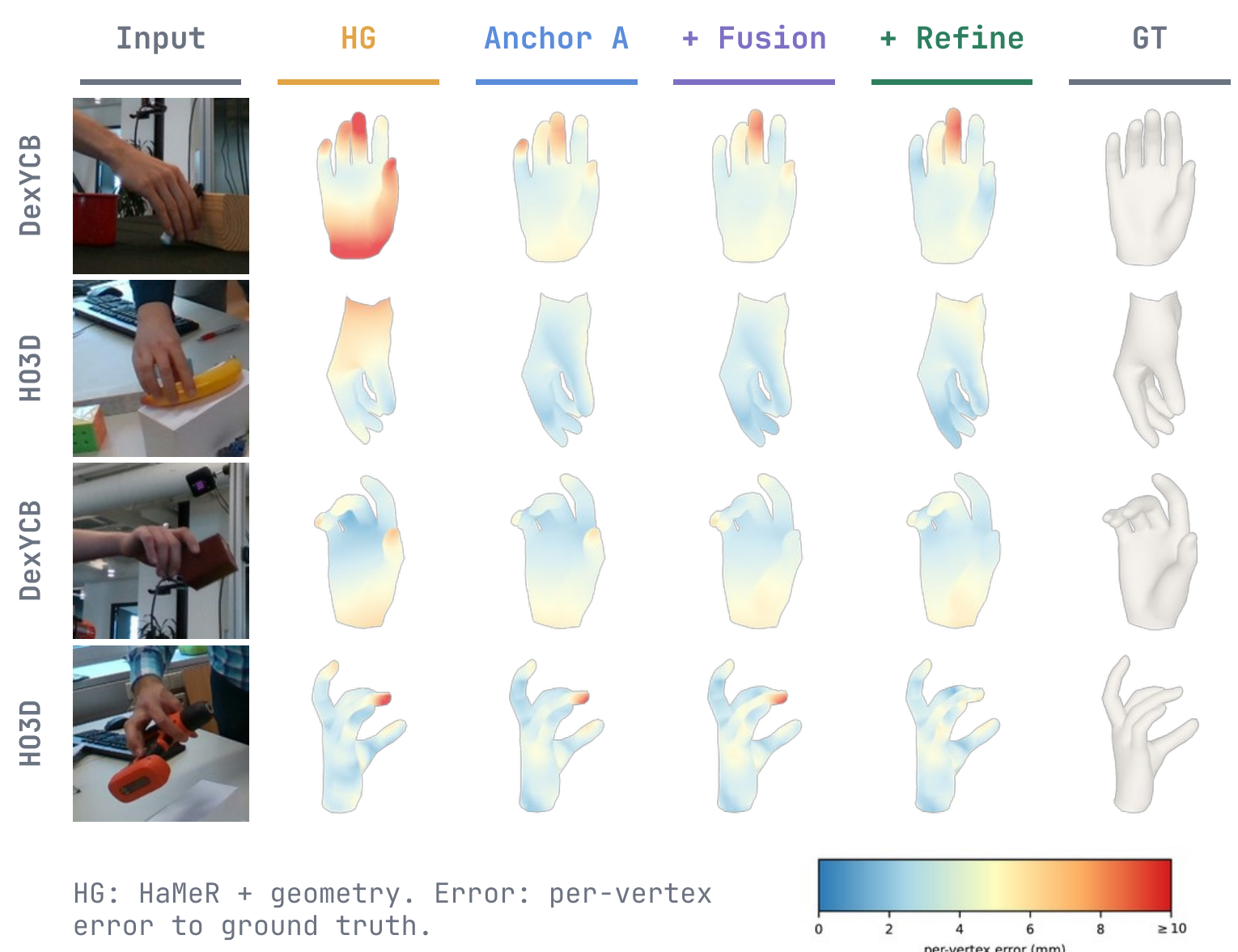
Development-set MPVPE (mm, lower is better) of the shared model.
| Configuration | DexYCB | HO3D |
|---|---|---|
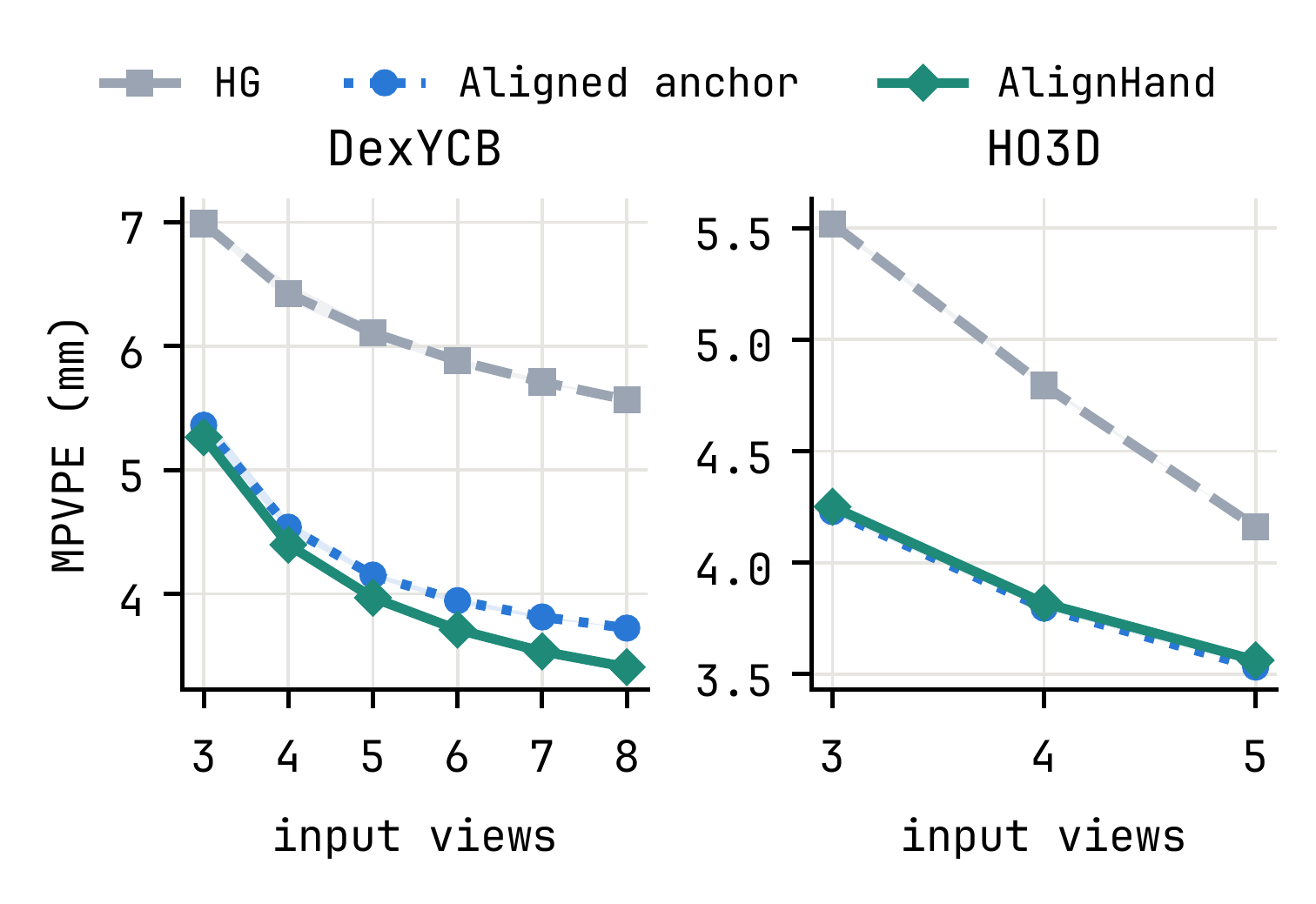
| Geometry baseline (HG) | 5.567 | 4.161 |
| Aligned anchor | 3.724 | 3.532 |
| + Regional fusion | 3.545 | 3.449 |
| + Pixel-aligned refinement (AlignHand) | 3.409 | 3.562 |
Table 2. Error after each stage. Regional fusion improves both datasets; pixel-aligned refinement helps on DexYCB but not on HO3D.
| Observation refinement (anchor only) | DexYCB | HO3D |
|---|---|---|
| Correction + predicted support | 3.724 | 3.532 |
| No correction; predicted support | 4.398 | 3.837 |
| Correction; uniform support | 4.345 | 3.628 |
| No correction; uniform support | 5.540 | 4.155 |
Table 3. Ablation of 2D joint correction and predicted view reliability at the aligned anchor (fixed checkpoint).
BibTeX
@misc{yang2026alignhand,
  title  = {AlignHand: Multi-View Hand Reconstruction from a Frozen Monocular Prior},
  author = {Yang, Zhilu and Yang, Kun and Wang, Shiyan and Xu, Anqi and Huang, Xinran
            and Jiao, Yizheng and Yang, Huan and Potamias, Rolandos Alexandros},
  year   = {2026}
}